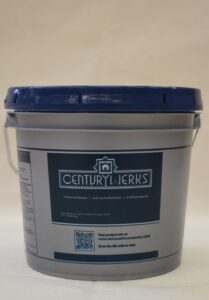
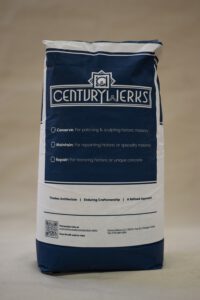
We manufacture and supply three families of pointing and bedding mortar, each suited to a different construction era and performance requirement:
St. Astier Natural Hydraulic Lime Mortar is recommended for repointing and rebuilding historic masonry, and it’s also recommended for historic plaster and stucco restoration. NHL mortars set through a combination of carbonation and hydraulic reaction, giving installers working time along with an earlier set time than traditional nonhydraulic lime putty.
Pozzolanic Hydraulic Lime 5.0 is our exclusive manufactured hydraulic lime, engineered for repointing and rebuilding historic masonry where early strength is needed without sacrificing vapor permeability or fle.
Midcentury Portland Lime Type O and Type N Mortars are strength-controlled, property-mixed formulations designed for repointing twentieth-century masonry built with early portland cement blends, where a conventional C270 portland-lime mortar would be too high strength.
As a dedicated historic mortar supplier, we have subjected our products to extensive testing and we perform rigorous quality control. For more information please review our technical downloads and our product submittals give architects the documentation for specifications. Our team of preservation experts is also a resource for contractors and specifiers who need assistance.
Maintain: Pointing & Bedding Mortars for Historic Masonry
If you're a restoration professional you already know the risk of getting it wrong. Modern Portland cement mortars are often harder and less permeable than the historic masonry units around them, and a harder mortar traps moisture, accelerates freeze-thaw damage, and can destroy brick or stone that survived a century of weather on its own.
CenturyWerks designs and manufactures lime mortar specifically to match the strength, permeability, and appearance of the historic material, so contractors and specifiers can make seamless repairs to historic buildings.
Why Compatibility Comes First
Brick and stone laid before the widespread introduction of portland cement were built with lime-based mortars that are softer than the masonry units themselves. That's intentional: mortar is meant to be the sacrificial element, absorbing stress and moving water out of the wall system so the brick or stone doesn't have to. Every product in our Maintain line is built around that principle, whether the project calls for a pure lime binder or a controlled-strength blend for later 20th-century construction.
Designed for Restoration Professionals
Our specifier resources support specifiers and installers with ASTM-referenced testing and product as well as guidance we provide based on our team’s extensive experience. Our installer resources provided detail guidance on mixing ratios, working time, and application guidance so crews aren't troubleshooting on site.
We also provide material testing services to enable architects and contractors to specify appropriate restoration mortar. We offer a range of mortar testing and analysis service that identifies the existing binder, aggregate, and color so the repair blends in rather than standing out. Our services range from the full ASTM C1324 “Standard Test Method for Examination and Analysis of Hardened Historic Masonry Mortar” to basic acid digestion and aggregate grading. Our custom material matching and blending team then uses that information to create a replacement mortar that replicates the appearance and performance characteristics of the original.
Repointing Isn't the Only Repair We Cover
If your project involves historic or unique concrete rather than masonry units, see our Repair line. For patching, carving, and sculpting historic masonry surfaces, our Conserve line is built for that scope.